
How UK Horse Racing Odds Work: Fractions, Decimals and Implied Probability
 Available in US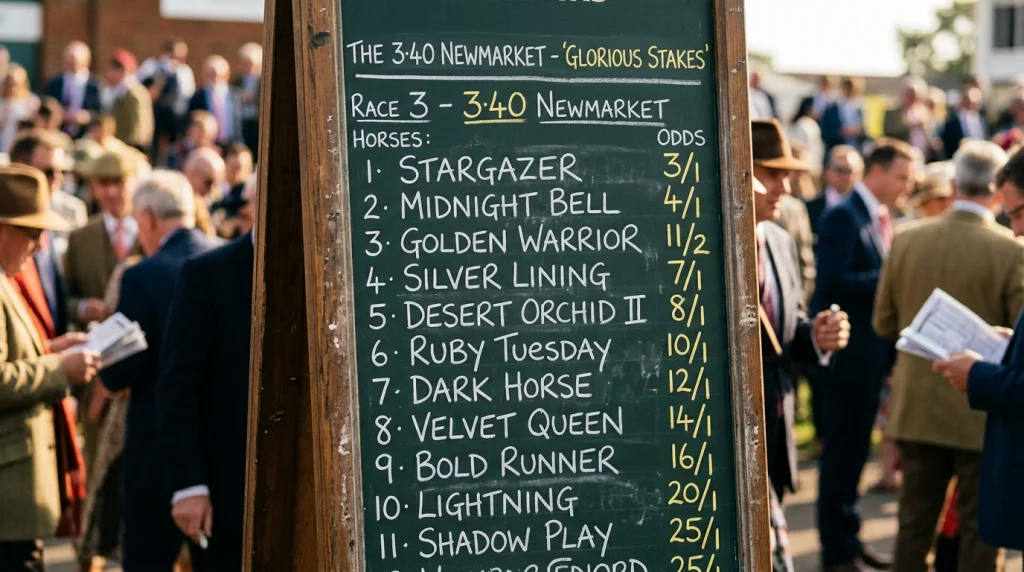
Contents
Why odds are the single most important number on the card
I spent the first two years of my betting life ignoring odds. I’d back a horse because I liked the name, the jockey’s silks, or a tip from a colleague who “knew someone in the yard.” It took a brutally cold January afternoon at Kempton – and a 5/2 winner that I’d backed at 6/4 an hour earlier – to make me sit down and learn what those numbers actually mean. That single race probably cost me forty quid in unnecessary margin. Over a season, that kind of leak compounds into hundreds.
Odds are not decoration on a racecard. They are the single most compressed piece of information available to you before a race. A price tells you how much you stand to win relative to your stake, how the market rates each runner’s chance, and – if you know how to read it – how much margin the bookmaker has baked into the book. Every other skill in racing analysis, from reading form to assessing the going, feeds into one question: is this price fair? You cannot answer that question without understanding how odds work.
The UK racing market still presents odds in multiple formats. Fractional prices dominate on-course and in traditional bookmaker advertising. Decimal prices rule the exchanges and are increasingly the default for younger punters. Behind both sits implied probability, the mathematical bridge that lets you compare any price with your own assessment of a horse’s chance. Online betting turnover on British racing fell by over 1.6 billion pounds across two years to March 2026, and tighter markets mean that understanding the price you take has never been more important – every fraction of a point matters when volumes are under pressure.
This walkthrough covers each format from first principles, shows how to convert between them instantly, explains the difference between Starting Price and Betfair SP, and unpacks the bookmaker overround so you can see exactly where the house edge sits. By the end, you will read a market the way a bookmaker writes one.
The fractional tradition: how UK prices are written
Stand in the betting ring at any British racecourse and you will see prices chalked up as fractions: 5/1, 7/2, 11/8. This is the oldest odds format in continuous use anywhere in the world, and it tells you two things at once. The number on the left is what you win. The number on the right is what you stake. At 5/1, a one-pound bet returns five pounds of profit plus your stake back – six pounds total. At 7/2, a two-pound stake returns seven pounds profit, so nine pounds total.
The beauty of fractional odds is their directness when stakes match the denominator. At 3/1, every pound wins three. At 9/2, every two pounds wins nine. The trouble starts when the fraction does not simplify so neatly. I remember staring at 100/30 on a bookmaker’s board at Cheltenham and thinking it looked bizarre – until I realised it is just another way of expressing 10/3. Both mean the same thing: for every three pounds staked, you receive ten pounds profit. UK bookmakers occasionally post non-standard fractions to avoid rounding, especially in early-morning trading when they are pricing up twenty-runner handicaps.
Some common prices have names etched into racing culture. “Evens” means 1/1 – stake a pound, win a pound. “Odds-on” describes any price shorter than evens, like 4/5 or 1/2, where you risk more than you stand to gain. “Odds-against” is anything longer, from 6/5 upward. These terms appear in commentary, in Racing Post analysis, and in conversations at the rail. If you are new to UK racing, learning the handful of standard fractional prices – 5/4, 6/4, 7/4, 2/1, 5/2, 3/1, 7/2, 4/1, 9/2, 5/1 and the less common 11/10, 11/8, 13/8 – will let you follow almost any market discussion without pausing to calculate.
One important nuance: fractional odds only represent profit relative to stake. They do not include the stake in the return figure. When you hear a punter say “I got fives” about a 5/1 winner, they mean they received five times their stake in profit, not five times their stake in total. This distinction matters when you start converting between formats or calculating accumulator returns, because misreading it by even one unit on a multiple can turn a winning afternoon into a losing one.
The fractional system carries a cultural weight in British racing that goes beyond practicality. On-course bookmakers still shout prices in fractions. The Racing Post still publishes forecasts in fractions. Television pundits still say “he’s a 9/4 chance” rather than “he’s 3.25.” If you want to bet on UK racing with any fluency, fractions are the native language.
Decimal odds: the exchange-era standard
When Betfair launched in 2000, it forced a generation of British punters to learn a second language. Decimal odds – 3.50, 5.00, 1.80 – are the global standard on exchanges, across continental Europe, and increasingly inside UK sportsbook apps that let you toggle format. The format originated in continental pari-mutuel markets, but it has stuck because it is mathematically cleaner than fractions for one crucial reason: the number you see is your total return per unit staked, including the stake itself.
At decimal 3.50, a one-pound bet returns three pounds fifty in total – two pounds fifty profit plus your original pound. At 5.00, the same stake brings back five pounds total, equivalent to 4/1 in fractional terms. At 1.80, you get one pound eighty back, meaning just eighty pence profit on a pound. The mental maths is simpler: multiply your stake by the decimal price and you have your total return. No second step, no “plus your stake back” afterthought.
I switched to decimals permanently around 2019. The trigger was accumulator calculation. If you are combining four legs in fractions – say 5/4, 7/2, 2/1 and 11/4 – you need to convert each price to “returns” format (2.25, 4.50, 3.00, 3.75), then multiply them together to get the combined return per pound. With decimals, you skip the conversion step entirely. The four legs multiply to 113.91, meaning a one-pound stake returns 113 pounds 91 pence. Try doing that in fractions without a calculator and you will see why the exchange generation never looked back.
Decimals also expose odds-on prices more transparently. A fractional 4/6 looks like something that requires a moment’s thought. Its decimal equivalent, 1.67, immediately tells you that every pound staked returns one pound sixty-seven. The shorter the decimal, the stronger the implied chance – and the less profit per unit staked. Anything below 2.00 is odds-on; anything above is odds-against. The dividing line is 2.00, which is evens.
The only real downside to decimals in UK racing is social. Mention “3.75” at the Cheltenham parade ring and you will get blank looks from anyone over fifty. But on screen, in spreadsheets, and in any form of data analysis, decimals win. They are the language of precision, and precision is what separates a good betting year from a mediocre one.
Converting between fractions, decimals and implied probability
Every time I price up a race, I move between fractions, decimals and implied probability within the same thirty seconds. The conversions are mechanical once you do them a few dozen times, and they unlock the ability to compare any price against your own estimate of a horse’s true chance.
Fractional to decimal: divide the top number by the bottom number, then add one. At 5/2, that is 5 divided by 2 (equals 2.50) plus 1, giving 3.50. At 11/4, that is 11 divided by 4 (equals 2.75) plus 1, giving 3.75. At 1/3 (odds-on), that is 1 divided by 3 (equals 0.333) plus 1, giving 1.333.
Decimal to fractional: subtract one from the decimal, then express the result as a fraction and simplify. At 4.00, subtract 1 to get 3.00, which is 3/1. At 2.25, subtract 1 to get 1.25, which is 5/4. At 1.80, subtract 1 to get 0.80, which is 4/5. Some decimals produce ugly fractions – 3.60 minus 1 gives 2.60, which is 13/5 – and that is exactly why some prices look odd on a bookmaker’s board.
Decimal to implied probability: divide 1 by the decimal price, then multiply by 100 to express as a percentage. At 4.00, implied probability is 1 divided by 4.00, which equals 0.25, or 25%. At 2.00 (evens), it is 50%. At 1.50 (1/2 in fractions), it is 66.7%. This is the step most punters skip, and it is the one that matters most.
Here is why. Suppose you study the form for a six-runner novice hurdle and conclude that one horse has roughly a 40% chance of winning. The bookmaker offers 2/1 (decimal 3.00). The implied probability of 3.00 is 33.3%. Your assessment of 40% suggests the horse should be closer to 6/4 (decimal 2.50, implied probability 40%). Because the bookmaker’s price implies a lower chance than you believe, the bet carries positive expected value. That gap – between your estimated probability and the price’s implied probability – is the entire basis of profitable betting.
A quick reference for the most common UK prices will save you mental arithmetic in the heat of trading. 1/1 (evens) is 2.00 decimal, 50% implied. 2/1 is 3.00 decimal, 33.3% implied. 5/1 is 6.00, 16.7%. 10/1 is 11.00, 9.1%. 33/1 is 34.00, 2.9%. Memorise five or six of these anchors and you can interpolate the rest without a calculator. Win bets account for 36% of the UK horse racing betting segment, so most of the prices you encounter will sit between evens and 10/1 – the range where these conversions matter most on race day.
Starting Price (SP) and Betfair SP: what gets settled and why
A few years back I backed a horse at 3/1 with a high-street bookmaker at 10 a.m., then watched the price collapse to 6/4 by the off. My bet was settled at my 3/1 – the price I had taken. The person next to me had waited and taken “SP.” They got 6/4. Same race, same horse, vastly different returns. Understanding how Starting Price works – and when it helps or hurts – is essential to taking the right price at the right time.
Starting Price, or SP, is the official price of a horse at the moment the race begins. It is determined by on-course bookmakers through a process overseen by SP reporters from the Starting Price Regulatory Commission. These reporters survey the prices being offered in the ring just as the stalls open or the tape rises, and the SP reflects the consensus of those live markets. If you place a bet at SP with a bookmaker, your payout is calculated at whatever that final on-course price turns out to be. You do not know your return until after the race starts.
Betfair SP is a different mechanism entirely. When the exchange introduced its own Starting Price product, it created a weighted average of unmatched bets in the Betfair market at the off. Because exchange markets tend to be more liquid and carry lower margins than the on-course ring, Betfair SP often (though not always) returns a slightly better price than the traditional SP. The difference is usually small – perhaps 3.20 on Betfair versus 3.00 traditional SP – but over hundreds of bets in a season, those fractions accumulate. Said Delmonte of the Horserace Betting Levy Board noted that bookmakers’ gross profits in February and March 2026 ran well above recent norms, with Cheltenham Festival results proving particularly bookmaker-friendly – a reminder that the unpredictability of the sport hits both punters and operators through the SP mechanism.
The key decision for any punter is whether to take an early fixed price or wait for SP. If you believe a horse’s price will shorten as money comes for it, locking in the early price gives you better value. If you suspect the horse will drift – perhaps the going changes, or the market spots a negative – SP might deliver a bigger number. There is no universal rule, but I find that for well-fancied horses in feature races, early prices are usually the smarter play because these horses attract heavy support as race time approaches, driving their SP down.
One quirk to note: many Best Odds Guaranteed offers settle at whichever is higher, your fixed price or the SP. That effectively removes the downside of taking an early price, which is why BOG has become central to shrewd racing punters’ strategies.
Board prices, early prices and the morning line
At 8 a.m. on a Saturday morning, most major UK bookmakers publish their initial prices for the day’s racing. These “early prices” – sometimes called “board prices” when they appear on the bookmaker’s physical or digital board – are the starting point of a negotiation that runs until the off. They are not final. They are opening offers, and they move.
The morning line is a related but distinct concept. In the strictest sense, a morning line is the first set of prices issued by a bookmaker’s trading team when they open a market, often the night before or in the early hours. These prices are informed by the racecard, the likely runners, the going forecast, and the weight of ante-post money already placed. Once early-morning punters start backing horses, the prices shift. A horse opened at 8/1 might be 6/1 by 10 a.m. and 4/1 by the off if it attracts sustained support.
For practical purposes, the distinction between “morning line,” “early price” and “board price” matters less than the underlying principle: the price you see at any moment is a snapshot of supply and demand, filtered through the bookmaker’s risk management. If a bookmaker has taken too much money on one horse, they shorten that horse and push out the others to rebalance liability. If a horse attracts no interest, its price may drift from 5/1 to 8/1 without anyone noticing.
I check prices at three specific points during a racing day: at the initial show (usually around 9 or 10 a.m. for afternoon cards), roughly 30 minutes before each race, and then at the five-minute mark when final market moves tend to happen. The biggest opportunities sit in the gap between the morning show and the 30-minute mark. That window is where informed money – from connections, from professional punters – tends to arrive, and where the prices that were too generous at 9 a.m. get hammered into shape.
Bookmakers know this, of course. Some will cap the stake they accept at early prices, or restrict certain accounts from taking the early show altogether. The tension between bookmaker risk management and punter access to early prices is one of the defining dynamics of UK racing in 2026, and understanding it is the first step toward spotting genuine value before the market corrects.
The bookmaker overround: where the margin comes from
Here is a question I ask anyone who tells me they “always back winners” – do you know what the overround was on the markets you bet into? Because backing winners at bad prices is the fastest route to a losing year.
The overround, also called the “book percentage” or simply “the margin,” is the amount by which the sum of all implied probabilities in a market exceeds 100%. In a perfectly fair market, the implied probabilities of every runner would add up to exactly 100. In reality, they add up to something like 112, 118 or even 130. That surplus is the bookmaker’s built-in edge.
To see it in action, take a hypothetical three-runner race priced at 2/1, 3/1 and 5/1. Convert to implied probabilities: 33.3% + 25.0% + 16.7% = 75.0%. Wait – that is under 100%. Something is wrong. Let me adjust to realistic prices: evens, 5/2 and 7/2. Now: 50.0% + 28.6% + 22.2% = 100.8%. The overround is 0.8%, which is tiny. In practice, a typical six-runner UK maiden race might carry an overround of around 110-115%, while a twenty-runner handicap can push to 125-130% in early trading.
The total gross gambling yield from remote betting across all sports reached 2.6 billion pounds in the 2026-2026 financial year, and the overround is the mechanism that generates that yield one race at a time. When a bookmaker writes a 120% book, they are building 20 percentage points of cushion into every market. Even if they pay out on winners, the maths of the full book should protect them in the long run.
For punters, the overround is actionable intelligence. Comparing the overround across multiple bookmakers for the same race tells you which operator is offering the thinnest margins – and therefore the best value. Exchange markets typically run at 101-103%, which is why exchange users often get better prices than those betting with traditional bookmakers. The trade-off is that exchange users pay commission on winnings, but even after commission, the effective overround is usually lower than a bookmaker’s fixed-odds market.
If you want to calculate the overround on any market, convert every runner’s price to decimal, compute 1 divided by each decimal, sum the results, and multiply by 100. The number you get is the book percentage. Anything above 100 is the margin you are paying. Over the nine months to September 2026, the gross gambling yield for remote horse racing alone was 766.7 million pounds – a figure built, race by race, on overrounds that most punters never bother to check.
Reading price movement: drifters, steamers and what they signal
Last spring I was looking at a 16-runner handicap at Newbury and noticed a horse drift from 8/1 on the morning show to 14/1 by the time I checked again thirty minutes before the race. No change in the going, no jockey switch announced – just a quiet, relentless leak of confidence. It finished tailed off. The market had seen something I had not, and the price movement was the only public signal.
A “steamer” is a horse whose price shortens rapidly, usually because of heavy, informed backing. The term implies that money is pouring in like steam from a kettle. A horse that opens at 10/1 and is backed into 5/1 by the off has been “steamed.” Steamers attract attention because their price movement often reflects genuine insider confidence – a trainer’s quiet word, a positive morning gallop, or a known professional landing a significant bet. That said, not every steamer wins. Sometimes the money is speculative or misguided. Blind-following every steamer is not a strategy; understanding why a horse steams is.
A “drifter” is the opposite: a horse whose price lengthens steadily. It opened at 3/1 and by the off it is 5/1 or 6/1. Drifters can indicate a horse that trialled poorly in the morning, a stable that is not trying today, or simply a lack of interest from informed punters. They can also indicate nothing at all – a horse might drift because money has arrived for a different runner, forcing the bookmaker to push this one out to rebalance the book. Context matters.
The most useful pattern to watch is a horse that drifts in the morning and then firms sharply in the final ten minutes before the off. That U-shaped movement often means the market initially underrated the horse, casual money pushed it out, and then late professional money snapped it up at a better price. I keep a mental note of these reversals, because over time they have been among the most reliable market signals I have tracked.
One caution: price movement on exchange markets and bookmaker markets can diverge. A horse might steam on Betfair because a single large backer entered the market, while the bookmaker boards barely move because their traders have not reacted yet. Comparing the two markets at the same moment gives you a richer picture of where genuine confidence lies. When bookmaker and exchange prices move together, the signal is strong. When they diverge, one of them is probably wrong, and working out which one is where the edge lives.
Favourites, value bets and the role of implied probability
Favourites win roughly one in three races in UK racing. That sounds good until you realise that most favourites are priced at 2/1 or shorter, meaning you need them to win more often than one in three just to break even. The favourite is not inherently good or bad – it is the price that determines whether backing it is smart or foolish.
Value is the gap between a horse’s true probability of winning and the probability implied by the price. If a horse has a 40% chance of winning and the bookmaker offers 3/1 (implied probability 25%), you are getting an overlay – a price that is bigger than it should be. Back enough overlays over time and the maths works in your favour, regardless of whether each individual bet wins or loses. This is not a theory; it is the only sustainable approach to profitable betting, and it applies at every price point from odds-on favourites to 33/1 outsiders.
The difficulty, of course, is estimating true probability. Nobody can know the exact chance of any horse winning a race. But you can build an approximate picture by studying form, assessing the going, accounting for draw bias, evaluating trainer and jockey patterns, and – crucially – comparing your conclusions to the market price. If, after a thorough assessment, you believe a horse is a 25% chance and the market says 16.7% (6/1), you have a potential value bet. If the market says 33.3% (2/1) and you think the horse is a 25% shot, you should leave it alone.
Win bets represent 36% of the total horse racing wagering market. Each-way accounts for 22%, with multiples and forecast/tricast bets making up the rest. Regardless of which bet type you prefer, the implied probability calculation applies. An each-way bet at 10/1 implies a different set of probabilities for the win and place components, and understanding those probabilities prevents you from taking each-way bets on horses that do not offer genuine place value. For a deeper look at finding overlays in UK markets, see the guide to horse racing value betting.
One more principle worth carrying forward: the market is not always right, but it is right more often than any individual. Your job is not to beat the market on every race. It is to identify the races where the market has made a mistake and to act on those races with appropriate stakes. That selective approach, grounded in the maths of implied probability, is what separates consistent punters from the crowd.
Odds: short answers to the questions punters ask
Recommend
Published by the bethorseracingonline.com team.
