
A Practical UK Horse Racing Betting Glossary: 60 Terms Decoded
 Available in US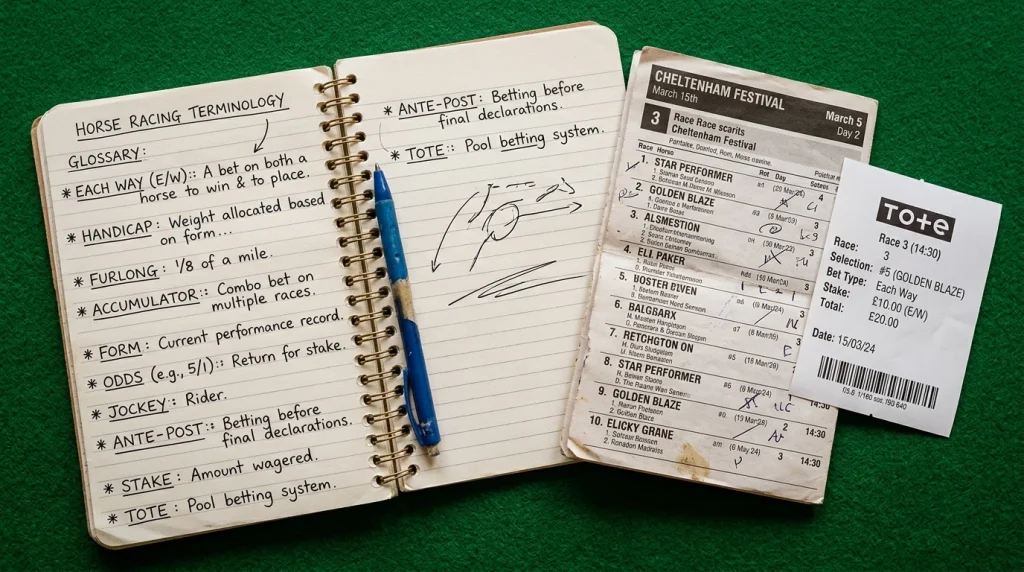
Contents
A glossary built for the betting slip, not the textbook
When I started betting on racing, the language was the first barrier. Not the complex stuff – I expected to have to learn about handicaps and going reports. It was the everyday vocabulary that tripped me up: what does “touched off” mean in a race summary? Why is a horse described as “keen” as if that’s a negative? What’s the difference between a “bumper” and a “maiden”? Racing’s terminology has evolved over centuries and borrows from equestrian culture, bookmaking slang, and regulatory jargon in roughly equal measure.
This glossary covers 60 terms that matter to punters. Win bets account for 36% of the UK horse racing betting market, with each-way at 22%, forecasts and tricasts at 17%, singles at 15%, and multiples at 10% – so the betting-specific terms are front-loaded. The racecard and regulatory terms follow, because understanding the card is the foundation of any selection process.
Odds and market terms
Starting Price (SP) – the officially returned price of a horse at the moment the race begins, determined by the on-course betting market. If you take SP rather than a fixed price, your bet is settled at whatever the horse’s odds are when the stalls open. Board price – the prices displayed by on-course bookmakers, which collectively determine the SP. Early price – odds available in the morning before the on-course market forms, typically offered by online bookmakers. Betfair SP – the starting price determined by matched bets on the Betfair exchange, often different from the traditional SP.
Best Odds Guaranteed (BOG) – a promotion where the bookmaker pays the higher of the fixed price you took and the SP if the SP is bigger. Drift – when a horse’s odds lengthen, indicating money moving away from it. Steamer – the opposite: a horse whose price contracts sharply, usually indicating significant money coming for it. Tissue – a bookmaker’s initial pricing estimate for a race, used before the market is formed.
Overround – the total margin built into the bookmaker’s prices for a race, calculated by summing the implied probabilities of all runners. An overround of 115% means the bookmaker has a 15% theoretical edge. Value – when the odds offered on a horse exceed your estimated probability of it winning. Overlay – synonymous with value: a price that is bigger than it should be. Underlay – a price that is shorter than justified by the horse’s true chance.
In-play – betting that takes place while a race is in progress, available on exchanges and some bookmaker platforms. Cash out – a feature allowing you to settle a bet before the race finishes, at a price calculated by the bookmaker based on the current in-play position. Rule 4 – the deduction applied to winning bets when a horse is withdrawn after the market has formed.
Bet-type terminology
Win bet – a bet on a horse to finish first. Place bet – a bet on a horse to finish in the places, with the number of places determined by field size. Each-way – two bets in one: a win bet and a place bet at a fraction of the win odds. Single – a bet on one selection in one event. Double – a bet combining two selections; both must win for the bet to pay.
Treble – three selections combined; all three must win. Accumulator (acca) – four or more selections combined, with winnings from each rolling onto the next. Forecast – predicting the first and second in the correct order. Tricast – predicting the first, second and third in the correct order. Reverse forecast – two horses to finish first and second in either order.
NRNB (Non-Runner No Bet) – a market term indicating your stake is refunded if your selection is withdrawn before the race. Ante-post – a bet placed well before race day, typically at longer odds but without NRNB protection unless specifically stated. Tote/pool bet – a bet into a communal pool where the dividend is determined by the total pool size and the number of winning tickets. Placepot – a Tote pool bet requiring a placed horse in each of the first six races on a card.
Racecard vocabulary
Form figures – the sequence of digits and letters next to each horse’s name showing recent finishing positions. A “1” means a win, “0” means finished outside the first nine, and letters indicate specific outcomes. F – fell. U – unseated rider. P – pulled up. R – refused. B – brought down. A dash separates different seasons.
OR (Official Rating) – the BHA’s assessment of a horse’s ability, used to allocate weight in handicaps. RPR (Racing Post Rating) – a privately calculated performance rating that may differ from the OR. Class – the grade of a race, from Class 1 (Group and Listed races) down to Class 7. Average field sizes on the Flat stood at 8.90 runners in 2026, but field sizes vary significantly by class – the higher the class, the smaller the typical field.
Going – the ground conditions on the racecourse, ranging from hard to heavy. Trip – the race distance. Draw – the stalls position allocated to each horse in Flat racing. Bumper – a National Hunt flat race, run without jumps, typically for young horses gaining experience. Maiden – a horse that has never won a race, or a race restricted to horses that have never won.
Stayer – a horse suited to long distances, typically two miles and beyond. Sprinter – a horse suited to short distances, five to six furlongs. Miler – a horse whose optimal distance is around one mile. Keen – a horse that pulls hard early in a race, using energy inefficiently. Travelled – describes a horse moving well within a race, typically sitting comfortably behind the pace. Touched off – beaten by the smallest of margins, typically a short head or a nose.
Regulatory and account terms
UKGC (UK Gambling Commission) – the regulatory body that licences and oversees all gambling operators in the United Kingdom. GAMSTOP – the national self-exclusion scheme covering all UKGC-licensed online operators. ADR (Alternative Dispute Resolution) – an independent complaints process available to customers of licensed operators.
Affordability check – a financial assessment conducted by operators to verify that a customer’s betting activity is within their means. Can be light-touch (invisible to the customer) or enhanced (requiring documentary evidence). Stake factoring – the practice of reducing the maximum stake accepted from a customer, typically applied to accounts identified as consistently profitable.
Levy – the 10% charge on bookmakers’ gross profits from bets on British racing, collected by the Horserace Betting Levy Board and distributed to fund prize money, integrity, and welfare. GGY (Gross Gambling Yield) – the total stakes minus winnings paid out; the standard measure of operator revenue. Remote Gaming Duty (RGD) – the tax on gross profits from online gambling, rising to 40% from April 2026. General Betting Duty (GBD) – the tax on sports betting profits, remaining at 15% for horse racing.
Glossary FAQ
Articles
Created by the "bethorseracingonline.com" editorial team.
