
The Going Report in UK Horse Racing: Reading the Ground Before You Bet
 Available in US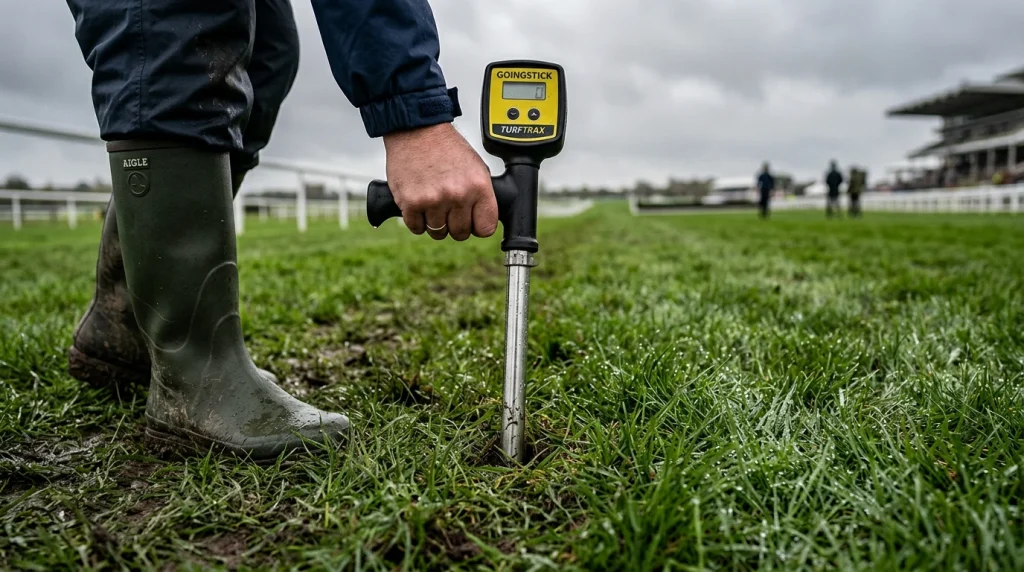
Contents
Why the going matters more than most punters think
Early in my career I backed a beautifully handicapped mare at Kempton on what was described as good-to-soft ground. She’d won on good and good-to-firm, and her odds had drifted because the forecast rain had arrived overnight. I convinced myself the ground change was marginal. She finished tailed off, hating every stride on the softer surface, and I learned a lesson worth far more than the stake I lost: ground conditions are not a footnote on the racecard. They are the single environmental variable with the greatest impact on which horse crosses the line first.
Nevin Truesdale, the former Jockey Club chief executive, once observed that the Gambling Commission seems to want to stop people gambling seamlessly rather than facilitating safe betting. His point was about regulation, but it applies to form analysis too — if you try to read a racecard without understanding the going, you are not facilitating your own success. You are ignoring the most powerful filter available.
The firm-to-heavy scale and what it means
UK going descriptions follow a standardised scale that runs from hard at the fastest extreme through firm, good-to-firm, good, good-to-soft, soft, and heavy at the slowest. Hard ground is rare on turf and usually carries a health warning from the BHA; heavy ground turns races into stamina tests that eliminate speed-reliant horses. The most common going descriptions in British racing fall in the good to good-to-soft range, which is why horses with proven form on those surfaces tend to accumulate the most consistent records.
The descriptions can be split further. A course might be described as good to firm in places, meaning the going varies across different parts of the track — typically firmer on higher ground and softer in hollows. These split descriptions tell you that the going is borderline, which in turn means that a single shower could push the entire surface into the next category. Borderline going is where the sharpest punters pay closest attention, because a shift after the market has priced the race can create overnight overlays.
The BHA’s fixture list for 2026 includes 1,458 meetings across every month of the year, spanning summer Flat cards on firm ground to midwinter jumps fixtures on heavy ground. The going’s impact varies by season, but its relevance never diminishes. Even all-weather meetings, run on synthetic surfaces, produce form that translates differently depending on whether the turf-equivalent going would be fast or slow.
The GoingStick and how clerks set the description
Until 2007, the going description was largely subjective — a clerk of the course would walk the track, poke the ground with a heel, and announce a description based on experience. The introduction of the GoingStick brought science into the process. The device measures both the penetration of the surface and the shear strength of the turf, producing a numerical reading that corresponds to a position on the going scale.
GoingStick readings are published by racecourses and available through form services. A reading above 8.0 generally corresponds to good-to-firm or firmer, 6.5 to 8.0 maps to good, 5.0 to 6.5 covers good-to-soft, and below 5.0 indicates soft or heavy. The clerk takes multiple readings across different sections of the course, and the official going description reflects an average.
Where the GoingStick becomes particularly useful for punters is in tracking the trend. A reading of 7.2 at 8am that drops to 6.4 by 1pm after steady drizzle tells you the surface is moving towards good-to-soft even if the official description hasn’t changed yet. The official description tends to lag behind reality, especially when weather arrives after the morning inspection. Monitoring the GoingStick readings through the day — published by Racing TV, At The Races, and on social media by course officials — gives you a real-time edge over punters who rely solely on the headline going description published the night before.
Reading ground preferences from form
Every horse has a ground preference, but not every horse’s preference is obvious from a surface-level glance at the form book. The challenge is separating genuine ground preference from coincidence. A horse that has won twice on soft ground may simply have been well handicapped on both occasions, with the going being incidental rather than causal.
I look for consistency across multiple runs on the same surface rather than just wins. A horse that finishes first, third, second, fourth in four runs on good-to-soft, but eighth, ninth, seventh in three runs on good-to-firm, is telling you something meaningful about its ground requirements — even though it hasn’t won on every soft-ground start. The pattern of finishing positions matters more than the individual results.
Pedigree offers supplementary evidence. Sires like Yeats, Getaway, and Kayf Tara tend to produce progeny that handle soft and heavy ground, while sons of Dark Angel and Showcasing are typically associated with faster surfaces. Pedigree is a starting point, not a verdict — individual horses within any sire line can buck the trend — but when form evidence is thin, as with lightly raced two-year-olds, sire data becomes a useful probability nudge.
Average turnover per UK race fell 5.8% across nine months of 2026, a statistic that partly reflects reduced field sizes and competitiveness. For form readers, smaller fields mean fewer data points per race, which makes ground-preference analysis even more important as a differentiator. When you have less form to work with, the evidence you do have — including surface performance — carries proportionally greater weight.
Late going changes and what to do
The going report published the evening before a meeting is a snapshot, not a guarantee. British weather is famously unpredictable, and the gap between the overnight forecast and the actual conditions at post time can be substantial. A dry night can firm the ground by a full description; a heavy shower two hours before racing can soften it just as dramatically.
My protocol for late going changes is simple. If the going moves in favour of a horse I’ve already identified as value, I increase my conviction but don’t increase my stake beyond my standard unit — the discipline of bankroll management overrides even the best situational edge. If the going moves against a horse I was planning to back, I scratch the bet entirely rather than reducing the stake. A half-hearted bet on a horse that has lost its ground advantage is dead money.
The other dimension of late going changes is their impact on the rest of the field. When the ground softens, look for non-runners among declared runners that need fast ground. Each withdrawal removes a competitor and can trigger Rule 4 deductions on existing bets, but it also reduces the quality of the race and may leave a soft-ground specialist facing weaker opposition than the morning market anticipated. Those moments — a late withdrawal of a fancied runner combined with a going change that suits a mid-priced contender — are among the most profitable situations I encounter across a typical racing season.
Going FAQ
Articles
Created by the "bethorseracingonline.com" editorial team.
