
The Grand National Betting Guide: Aintree’s Once-a-Year Punters’ Race
 Available in US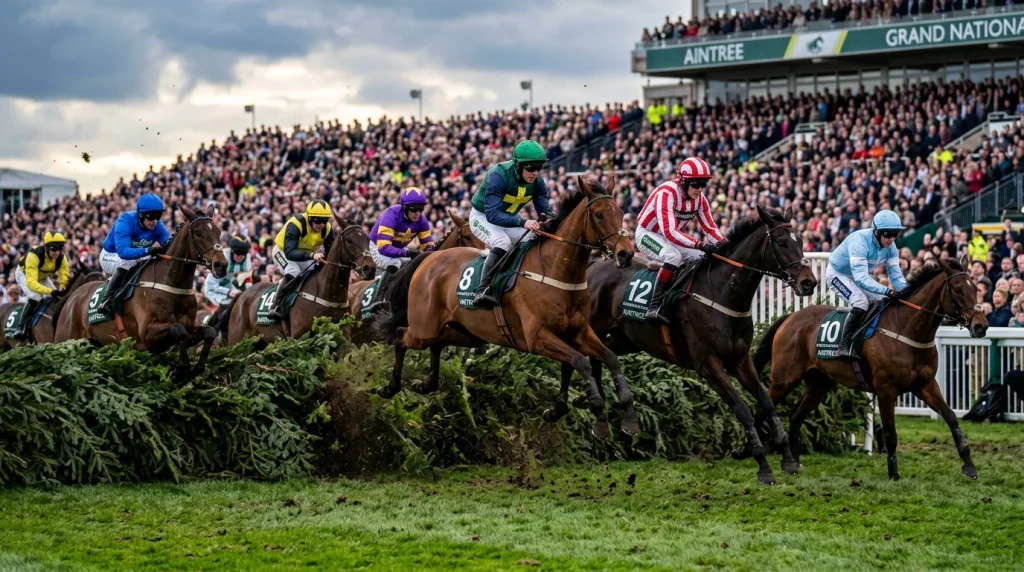
Contents
A race like no other in the British calendar
The Grand National turns people who never look at a racecard into punters for exactly ten minutes. Office sweepstakes, pub pools, WhatsApp groups sharing “lucky” picks — the first Saturday in April is the one day of the year when the entire country bets. I’ve watched it from the Aintree stands, from the sofa, and from behind a bank of screens tracking live odds, and the dynamic is always the same: a surge of uninformed money hitting the market, followed by four-and-a-half miles of chaos that humbles everyone equally.
Sixty-eight percent of racecourse ticket buyers across UK racing in 2026 were casual or first-time attendees, and nowhere is that ratio more extreme than on Grand National day. That casual influx transforms the betting market in ways that matter to serious punters. The money is loud, emotional, and sentiment-driven — backing the grey horse because it stands out, the one whose name sounds funny, or the favourite because the newspaper said so. Understanding that distortion is the first strategic advantage available to anyone who does the form work.
Format, distance and the new fence regime
The Grand National covers approximately four miles and two furlongs over 30 fences on Aintree’s National Course. It is the longest and most demanding race in the British calendar. The fences have been modified substantially since 2012 — the cores are now more forgiving, with softer padding — reducing the fall rate without eliminating the jumping challenge. Horses still need to be athletic, scopey jumpers, but the old narrative of the National as a “lottery” has become outdated. The modifications mean that class and jumping technique are rewarded more consistently than they were two decades ago.
The distance itself is a brutal filter. Horses that stay three miles well at conventional courses do not automatically stay four-plus miles at Aintree, where the undulating track, the unique fence profiles, and the emotional energy of the crowd all add to the physical demand. Staying form over three miles and beyond is essential, but so is evidence that the horse can travel within itself through the middle stages rather than burning energy early. Runners who race prominently through the first circuit and then fade from the Canal Turn onwards on the second circuit are one of the most consistent losing patterns in the race.
Weight, age and form pointers
Weight has always been central to Grand National analysis, but the profile of recent winners has narrowed. Over the past fifteen years, the sweet spot has settled around 10st 8lb to 11st 5lb, with horses at the top of the weights finding it increasingly difficult to defy the handicapper over the extreme distance. Younger horses — eight and nine-year-olds — have dominated the winners’ enclosure, with ten-year-olds still competitive but older runners increasingly struggling to maintain the stamina reserves the race demands.
Form at Aintree itself, whether over the National fences in the Becher Chase or the Topham, is the single most predictive data point I use. Horses that have completed the course before and handled the unique fence profiles confidently carry a measurable edge over those encountering the obstacles for the first time. Previous experience of the drop fences — Becher’s Brook, the Canal Turn, Valentine’s — builds a familiarity that no amount of schooling at home can replicate.
ITV’s coverage of the Grand National and wider Aintree meeting drew massive audiences in 2026, and the race’s profile ensures that ante-post markets are active from the previous autumn. Early prices on proven Aintree performers tend to contract sharply as the race approaches, so the value in the ante-post market often lies in backing a horse with strong course form before the public and media converge on the same names.
Place terms and extra-places offers explained
The Grand National is the single most generous each-way race of the year in terms of place terms. With 40 runners, most bookmakers pay six places at a quarter of the odds — and during promotional windows, some extend that to seven or even eight places. Those terms fundamentally change the arithmetic of each-way betting.
At six places with a field of 40, any horse with a realistic chance of finishing in the first six — say a 15-20% probability of placing — can represent strong each-way value if priced at 20/1 or longer. The place part of the bet at a quarter of 20/1 returns 5/1 for a place finish, and at 20% place probability that delivers clear positive expected value on the place component alone.
Extra-places promotions are most aggressively offered on Grand National day because bookmakers use the race as a customer-acquisition tool. Extending from six to eight places sounds like a small change, but it adds two additional finishing positions that survive — and those seventh and eighth finishers are precisely where the casual punter’s selections tend to cluster and lose in a standard six-place market. If you’re going to take an extra-places offer, check whether the bookmaker has reduced the odds fraction from 1/4 to 1/5. That reduction quietly claws back a substantial portion of the promotional benefit.
Pricing the once-a-year audience
The Grand National’s unique audience structure creates a market unlike any other race during the year. Roughly 290 million online bets are placed monthly across UK racing, but a disproportionate share of the annual total concentrates on this single afternoon. The once-a-year punter overwhelmingly backs names they recognise, narratives that have appeared in the press, and horses at the front of the market. This behaviour compresses the favourite’s price and inflates the prices of unfashionable contenders.
For the serious punter, the strategic response is straightforward: focus on horses between fifth and fifteenth in the betting. The very top of the market is over-backed and under-priced. The very bottom — 66/1 and 100/1 shots — are priced correctly or even generously, but their realistic chance of placing is too thin to offer consistent value. The middle tier, where odds range from 14/1 to 33/1 and where genuine form credentials exist, is where the casual money creates the most exploitable overlays.
I also pay attention to late-market moves. In the final 30 minutes before the off, on-course money from informed punters begins to correct the distortions created by the week-long build-up. If a horse at 25/1 contracts to 16/1 in the last half-hour, it’s worth checking whether the move is backed by stable confidence or simply the result of a well-placed newspaper tip circulating late. Distinguishing genuine market intelligence from noise is harder on National day than any other, but the punters who manage it consistently collect on the race that everyone else treats as a lottery.
Grand National FAQ
Articles
Created by the "bethorseracingonline.com" editorial team.
