
Royal Ascot Betting Guide: The Flat Season’s Five-Day Showpiece
 Available in US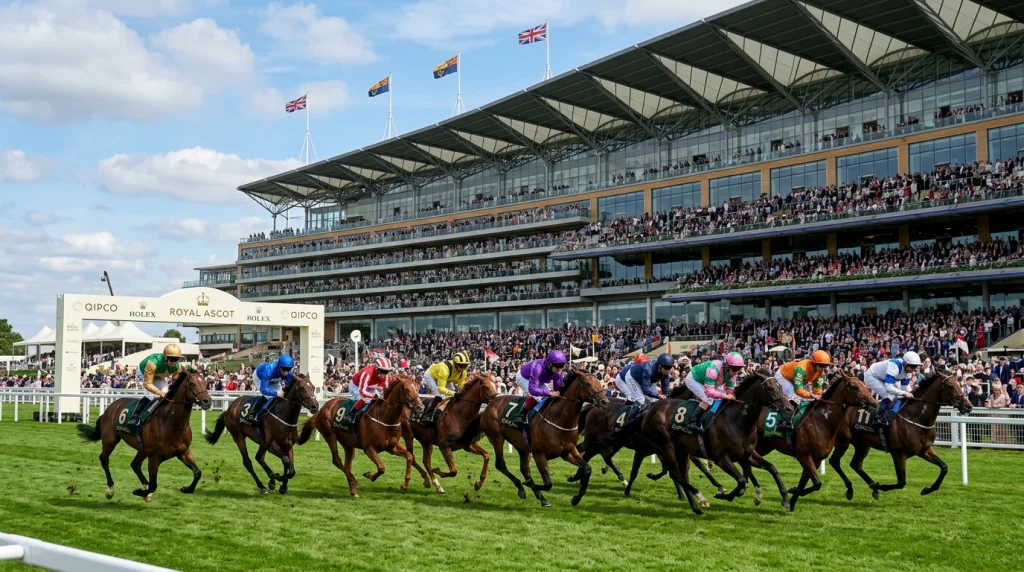
Contents
Royal Ascot’s place in the Flat calendar
If Cheltenham is the cathedral of jumps racing, Royal Ascot is its Flat equivalent — five days in June where the best horses in Europe, and increasingly the world, converge on a single Berkshire course. I think of it as the week that resets the entire Flat betting landscape. Ante-post markets for the rest of the season hinge on what happens here, and the sheer density of Group 1 quality makes it the most intellectually demanding meeting to price up correctly.
Brant Dunshea, the BHA’s chief executive, captured it well when he described racing as something that has been part of the British way of life for hundreds of years, binding communities together and putting the country on the world stage. Royal Ascot is the purest expression of that idea on the Flat side. Five million ITV viewers tuned in across the five days in 2026, and the meeting’s ability to attract both the hardcore racing audience and a broader cultural audience makes its betting markets some of the most liquid — and most distorted — of the year.
What each of the five days serves up
Royal Ascot’s card structure is designed to build across the week, and knowing the rhythm helps with bankroll pacing and market timing.
Tuesday, Champion Day, opens with the Queen Anne Stakes — a Group 1 mile race that typically features proven older milers returning from a spring break. It sets the tone for the meeting’s quality. The Coventry Stakes on the same card is the first major two-year-old contest of the season, and because the juveniles involved have limited public form, the market is unusually open and prone to sharp moves on stable intelligence.
Wednesday centres on the Prince of Wales’s Stakes at ten furlongs, often the race of the week from a pure quality standpoint. The Royal Hunt Cup — a mile handicap for a full field — is the day’s punting highlight, a cavalry charge where draw and pace frequently override raw ability.
Thursday’s Gold Cup at two-and-a-half miles is the stamina test that attracts the broadest media coverage. It’s also the day the casual audience peaks, which means market distortions are at their strongest. The Britannia Stakes, another huge-field handicap, rounds out a card that demands attention to detail in the lower-profile races where the public money is thinnest.
Friday and Saturday feature a blend of Group races and big-field handicaps. The Wokingham and the Queen Alexandra Stakes close out a week where even the supporting cards carry a level of competitiveness you rarely see elsewhere. For the disciplined punter, the later days can offer the best value because the once-a-week crowd has thinned and the market’s pricing becomes tighter.
The marquee Group 1 contests
Royal Ascot hosts eight Group 1 races across the five days — more top-level Flat contests than any other British meeting. The Queen Anne, Prince of Wales’s, Gold Cup, Commonwealth Cup, Coronation Stakes, St James’s Palace Stakes, King’s Stand and Diamond Jubilee collectively define the hierarchy of Flat racing for the season ahead.
From a betting perspective, the Group 1 races present a paradox. They attract the sharpest money and the most thorough form analysis from professional syndicates, which means the odds tend to be tightly priced and difficult to find genuine value in. But they also attract the heaviest recreational money, particularly on the Gold Cup and the Sprint races, which can push the favourite’s price below fair value and push mid-market contenders out to exploitable levels.
ITV’s renewed four-year contract for exclusive free-to-air coverage running from 2027 through 2030 ensures that Royal Ascot’s profile — and the casual money it draws — will persist through the next broadcast cycle. That media-driven audience effect is as much a structural feature of the meeting’s betting markets as the form itself.
Draw, ground and pace at Ascot
Ascot’s two distinct tracks — the round course and the straight mile — behave differently under different ground conditions, and ignoring the draw at this course is one of the costliest mistakes a punter can make during the Royal Meeting.
On the straight course, used for races up to a mile, the draw bias depends heavily on the going and the rail position. When the ground is on the faster side of good, high draws — racing against the far rail — have historically shown an edge, particularly in sprint races. When the ground is softer, the bias shifts or neutralises as the ground nearest the stands rail gets chewed up by earlier races. By day four or five, the stands rail can be significantly different from day one, and any draw data from Tuesday becomes unreliable for Saturday’s races.
On the round course, the draw matters less because the turn into the home straight allows jockeys to find their preferred racing position regardless of stalls placement. Pace, however, becomes critical. Ascot’s uphill finish over the final two furlongs punishes horses that race too prominently in fast-run Group 1 contests. A horse that sits third or fourth, travelling comfortably within its stride approaching the turn for home, has a structural advantage in races run at a genuine pace.
How TV coverage shifts late prices
The five million viewers watching ITV’s coverage don’t all watch quietly. A significant proportion of them bet live, reacting to on-screen tips, pundit recommendations, and the visual cues of the parade ring. This creates a measurable “TV effect” on late-market prices that I’ve tracked closely over the past four Ascot meetings.
The pattern is consistent. Between 20 minutes and five minutes before a race, horses highlighted by the ITV pundits typically shorten by one to three points on the fixed-odds markets, while the exchange price follows more slowly. The gap between the bookmaker price and the exchange price during this window can be exploited if you’re quick enough — but the real opportunity runs the other way. The horses the cameras ignore, the ones not discussed in the preview, drift in price precisely when their actual chance hasn’t changed. If your pre-race analysis has already identified one of those horses as value, the late drift makes the value even sharper.
Total UK racecourse attendance surpassing five million in 2026 reflects a renewed public appetite for live racing, and Royal Ascot captures a disproportionate share of that energy. For the betting analyst, the message is clear: crowd dynamics and media amplification are not distractions from the form — they are additional data points that shape the market you’re trading into.
Royal Ascot FAQ
Articles
Prepared by the bethorseracingonline.com editorial staff.
