
Cheltenham Festival Betting: Trends, Trial Races and How Markets Form
 Available in US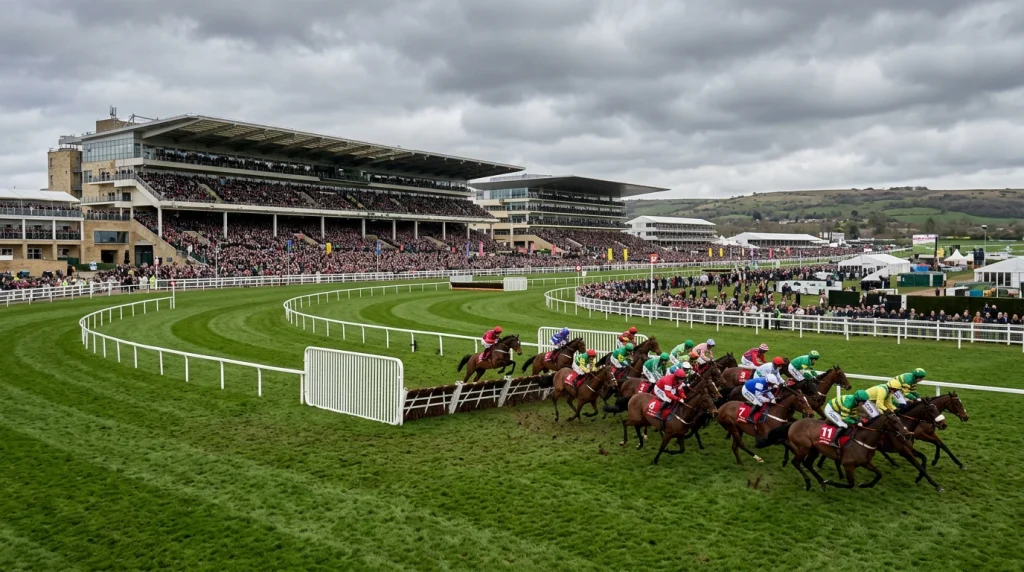
Contents
The Cheltenham Festival in punters’ calendars
No meeting in the British racing year carries more weight in a punter’s diary than the four days in March when Prestbury Park becomes the centre of the National Hunt universe. I’ve been to every Festival since 2018, and the atmosphere the moment you walk through the gates on Champion Day is unlike anything else in the sport — a wall of noise, a packed betting ring, and the collective knowledge of thousands of serious jumps punters being thrown at 28 races over four days.
Cheltenham is where reputations are made and destroyed, for horses and punters alike. Total racecourse attendance across the UK hit 5.031 million in 2026 — the first time it had crossed five million since before the pandemic — and a significant slice of that number walks through the Cheltenham gates across those four days. Peak TV viewership on Gold Cup Day reached 1.8 million, the strongest figure in four years, confirming that the Festival’s gravitational pull extends far beyond the course itself.
Trial races that shape Festival markets
The Cheltenham ante-post markets start forming months in advance, but they don’t move in a vacuum. A handful of trial races between November and February act as the critical data points that swing prices, end campaigns, and launch new contenders. Knowing which trials matter — and which are red herrings — is the first step to pricing up Festival races accurately.
For the Champion Hurdle, the Christmas Hurdle at Kempton and the Irish Champion Hurdle at Leopardstown are the two definitive trials. A strong performance in either consistently correlates with Cheltenham form. The Contenders Hurdle at Sandown in February, run over the same two-mile trip, provides the final domestic test. If a horse wins convincingly at Sandown and arrives at Cheltenham with form on ground softer than good, it warrants serious consideration.
The Gold Cup trials are spread wider. The King George at Kempton on Boxing Day remains the marquee mid-season test for staying chasers, but the correlation with Cheltenham is less reliable than many assume — Kempton is flat and right-handed, Cheltenham is undulating and left-handed. The Denman Chase at Newbury and the Cotswold Chase at Cheltenham itself, both run in February, offer more course-relevant evidence.
What I’ve learned to watch for in trials is not just the result but how the horse achieved it. A horse that travels powerfully before being eased down tells you more than one that was pushed from the top of the hill to win by a neck. The manner of a trial victory — how much the jockey was asking, whether the horse jumped fluidly or scraped through — often contains more useful information than the bare finishing position.
Long-term trends across the four days
Statistical trends at Cheltenham demand a health warning: no trend persists forever, and the moment one becomes widely known, the market absorbs it and the value disappears. With that caveat, several patterns have held up across the past decade of Festivals and remain worth weighting into your probability estimates.
Irish-trained raiders consistently outperform the raw market expectation across all four days, particularly in the novice contests. The influx of horses from Willie Mullins, Gordon Elliott, and Henry de Bromhead has not diluted the pattern — if anything, the depth of Irish entries has widened it. When an Irish novice hurdler is second or third in the betting on the morning of the race, the actual win probability tends to exceed the implied probability of the price.
Front-runners historically struggle up the Cheltenham hill. The unique topography of the course — a steep uphill finish after two miles or more of racing — punishes horses that lead from an early stage, especially in two-mile races where the pace is fierce. Hold-up horses with proven stamina for the final hill have a measurable edge that casual punters often underweight because they focus on speed figures rather than finishing effort.
The other durable trend is the Friday handicap effect. By day four, the ground has taken significant wear, and horses drawn or racing on the inside rail — the most trafficked ground — face deteriorated footing. Horses with proven soft-ground form who can race wide tend to outperform on the final day, particularly in the big handicap hurdles.
Why favourites underperform here
Cheltenham is famous for upsets, and the numbers back the reputation. Over the past ten years, the favourite’s strike rate across the 28 races has hovered around 28-30%, notably lower than the average for UK jumps racing generally. Several structural factors drive this.
Field quality is the most important. Championship races attract the best horses from Britain, Ireland, and occasionally France. The gap between the favourite and the fifth horse in the betting is much smaller than at a routine midweek meeting. When the margins are thinner, the likelihood of any single horse dominating decreases. It’s the sporting equivalent of a knockout tournament versus a league season — upsets are structurally more frequent when the talent is concentrated.
The second factor is market distortion from the once-a-year audience. Cheltenham attracts more casual money than any other jumps meeting, and that money overwhelmingly backs the names they recognise. Media narratives, newspaper tips, and social media hype compress the favourite’s price below its true probability, creating negative value on the front of the market and, conversely, pushing out the prices on less fashionable contenders. For the disciplined form reader, this is the Festival’s single greatest gift.
Each-way thinking for huge fields
Cheltenham handicaps routinely field 20 or more runners, which means bookmakers typically pay four places at a quarter of the odds. With fields that large, the each-way place bet becomes a weapon — especially when you target horses in the 12/1 to 25/1 range whose place probability exceeds the implied probability of the place portion of the each-way terms.
My approach in Festival handicaps is to identify three or four horses whose form, going preference, and course profile give them a genuine chance of finishing in the first four, then assess whether the each-way terms on any of them represent positive expected value on the place part alone. If the place bet is positive-EV, the win part is a free shot at a bigger payout rather than the primary target. This flips the usual each-way thinking on its head: you’re not hoping the horse wins and settling for a place; you’re targeting the place and treating the win as a bonus.
Extra-places promotions are common during Festival week, with some bookmakers paying five or six places in the biggest handicaps. These enhanced terms can shift a marginal each-way selection into clear positive-EV territory, but always check the conditions. Some enhanced-places offers come with reduced odds fractions or maximum stake limits that erode the apparent benefit.
Cheltenham FAQ
Articles
Prepared by the bethorseracingonline.com editorial staff.
