
Horse Racing Value Betting in the UK: Finding Prices the Market Has Missed
 Available in US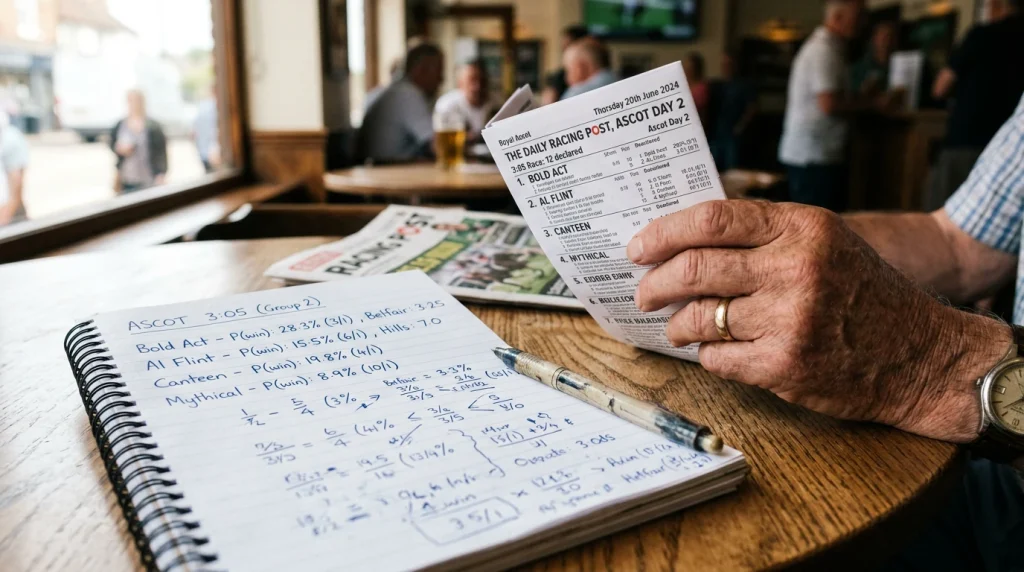
Contents
What value really means in a horse racing market
I backed a 14/1 shot at Haydock three years ago that finished stone last. Best bet I made that month. Not because the horse ran well — it didn’t — but because my numbers said the true price should have been closer to 8/1, and when you consistently take those edges, the losing days stop mattering. That single idea separates punters who grind out profit from those who celebrate the odd winner while their bank quietly bleeds.
Value, in its bluntest form, is a discrepancy between the price a bookmaker offers and the actual likelihood of the outcome. If a horse genuinely wins one race in five, its fair odds are 4/1. Any bookmaker quoting 6/1 is handing you an overlay — a price bigger than the event deserves. Back enough overlays over enough races and mathematics tilts the ledger your way, regardless of individual results. The concept borrows from financial markets: you are not predicting winners, you are pricing risk more accurately than the person on the other side of the trade.
Most recreational punters think backwards. They find a horse they fancy, then check whether the odds feel “big enough.” Value bettors reverse the sequence: estimate probability first, then see whether the market is offering more than that probability warrants. The distinction sounds academic, but it is the single most consequential shift you can make in how you approach a racecard.
Estimating true probability against market odds
Here is where most guides lose people. They talk about “assessing true probability” as though you need a PhD and a server farm. You don’t. What you need is a disciplined process and an honest relationship with uncertainty.
Start with the market itself. Strip the bookmaker’s overround — that built-in margin typically running between 110% and 125% on a UK horse racing market — and you get a raw implied-probability picture of every runner. A horse priced at 5/1 carries an implied probability of roughly 16.7% before margin. Once you deflate every runner’s implied chance proportionally so the total equals 100%, you have the market’s genuine opinion. This is your baseline, not your answer.
Next, layer your own assessment on top. I work through five filters for every race: recent form figures relative to today’s class, proven ability on the prevailing going, distance suitability backed by finishing speeds rather than gut feel, trainer intent signals such as equipment changes or a step up in jockey, and pace-map position given the likely shape of the race. Each filter nudges a horse’s probability up or down from the market baseline. You don’t need decimal precision. If the market says 12% and your filters push a horse to 18-20%, that is a meaningful gap.
Online betting turnover on UK racing dropped by about 1.6 billion pounds over two years to March 2026, shrinking the pool of sharp money that keeps prices efficient. Thinner markets mean more mispricings — more overlays hiding in plain sight, especially on midweek cards where bookmaker traders rely heavily on algorithmic pricing rather than manual oversight.
The critical discipline is recording your probability estimates before the off, then tracking results over hundreds of bets. If your 20%-rated selections win around 20% of the time at average odds above 4/1, you are genuinely finding value rather than fooling yourself.
Where overlays hide on UK cards
A Tuesday card at Wolverhampton is not Royal Ascot, and that is precisely the point. The biggest overlays tend to cluster in situations the wider market pays least attention to. Nine years of tracking my own bets have taught me to look in three places first.
Handicaps with large fields are the richest hunting ground. When sixteen runners line up for a Class 4 handicap, the bookmaker has to price every one of them. The front of the market — the first three or four in the betting — attracts most of the money and gets priced tightly. Runners from fifth in the market outward receive less scrutiny and often carry inflated overround. A horse returning from a break with a trainer who deliberately targets a fresh handicap mark can drift to 16/1 or 20/1 while its realistic chance sits closer to 10/1. Win bets account for 36% of the UK horse racing betting market, and the majority of that money lands on shorter-priced selections, which leaves the mid-range and outsiders comparatively loose.
Conditions races for unexposed horses offer a different kind of edge. Two-year-old maidens in June and July feature debutantes with no public form. The market prices them largely on pedigree, trainer, and gallop rumours. If you spend time tracking private-trial whispers or studying a trainer’s history with specific sire lines at specific tracks, you can build a probability picture the market hasn’t fully absorbed.
The third zone is going-dependent specialists. When the ground changes late — a heavy shower turning good-to-firm into good-to-soft an hour before post — the market adjusts the obvious contenders but frequently underestimates the improvement in a proven soft-ground horse sitting at the bottom of the market. I keep a shortlist of horses whose form figures transform on cut ground, and I watch for those late going updates like a hawk. Managing your staking plan properly ensures you can exploit these opportunities without overextending on any single race.
Calculating expected value on a single bet
I used to avoid the maths, thinking intuition was enough. It wasn’t. Expected value — EV — is the formula that tells you whether a bet is worth placing regardless of how today’s race finishes. Once you see it, you can’t unsee it, and it changes every decision you make at the racecard.
The calculation itself is straightforward. Multiply the probability you assign to the horse winning by the profit you’d collect, then subtract the probability of losing multiplied by your stake. In practical terms: you rate a horse at a 25% chance of winning, and the bookmaker is offering 5/1. If you stake 10 pounds, a win returns 50 profit. EV equals (0.25 times 50) minus (0.75 times 10), which gives you 12.50 minus 7.50, equalling positive 5.00 per bet on average. That is a strong overlay.
Now flip it. Same horse, same 25% probability estimate, but the price is 3/1 instead of 5/1. EV becomes (0.25 times 30) minus (0.75 times 10), which is 7.50 minus 7.50 — exactly zero. No edge. The horse might still win, but taking that price repeatedly will grind your bank sideways at best.
The crucial lesson is that EV only reveals itself over volume. A single bet is just noise. Across 200 or 500 bets at positive EV, the profit curve trends upward despite inevitable losing streaks. This is why record-keeping matters more than any single selection. If you are not logging your estimated probability, the actual odds taken, and the outcome for every bet, you have no way of knowing whether your edge is real.
Common pitfalls in chasing value
The biggest trap is confusing big odds with value. A 33/1 shot is not automatically an overlay. If the horse’s realistic chance is one in fifty, that price is actually short. I fell into this early in my career, backing longshots because they “looked like value” without doing the probability work. It felt exciting. It was expensive.
Confirmation bias is the second killer. You fancy a horse, so you unconsciously inflate its probability to justify the bet. The antidote is blinding yourself to the price until after you’ve completed your assessment. Write down your estimated percentage first, then open the betting market. If the odds exceed your fair price, bet. If they don’t, walk away — no matter how much you like the horse.
Nevin Truesdale, the former Jockey Club chief executive, put it bluntly when he said the Gambling Commission appears to want to reduce gambling to just small-stakes gamblers, arguing that approach misses the point. For value bettors the regulatory squeeze matters because affordability checks disproportionately affect the consistent, higher-volume punters who rely on staking enough to let positive EV compound over time. A forced reduction in stake size can neutralise an edge that is mathematically sound.
Overestimating your own skill is the third pitfall. Track your results honestly. If your actual strike rate at a given probability band consistently falls below your estimates, your model is leaking somewhere. Adjust the inputs rather than blaming bad luck. Value betting is a process, not a prophecy, and the punters who survive long-term are the ones who treat their own numbers with the same scepticism they apply to the bookmaker’s prices.
Value-betting FAQ
Articles
Prepared by the bethorseracingonline.com editorial staff.
