
Best Odds Guaranteed in UK Horse Racing: How BOG Really Works
 Available in US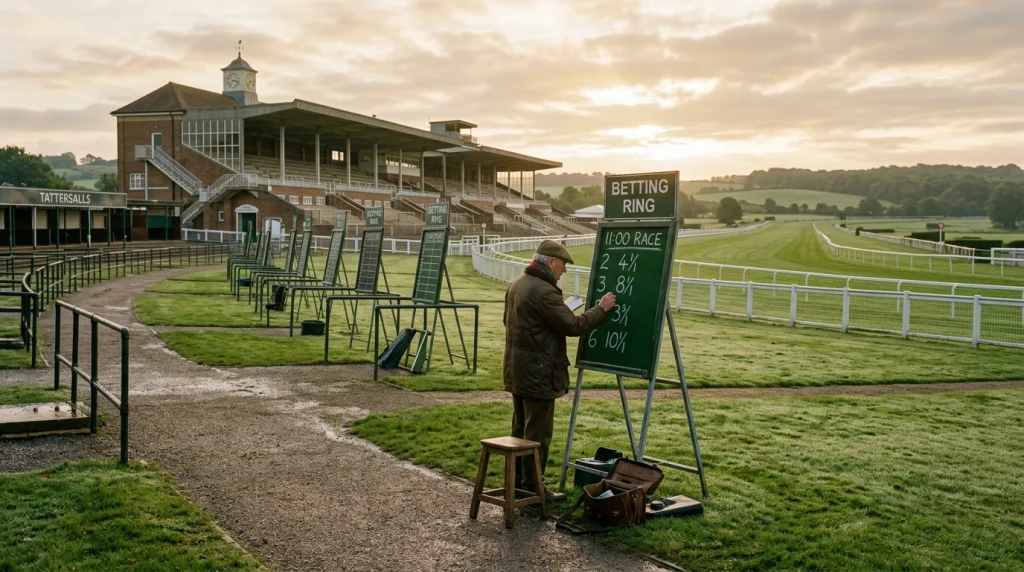
Contents
What BOG is and why it became a UK standard
I backed a horse at 5/1 one morning for a 3:15 at Haydock. By post time, the SP had come in at 7/2. In the old days that would have been a bitter pill – I took the price, I live with it. But this time, my account was credited at 5/1. Best Odds Guaranteed had done its job, silently bumping my return to the better price. No claim form, no phone call. It just happened.
BOG is so embedded in UK racing culture now that most punters take it for granted. But when I started betting nine years ago, only a handful of operators offered it, and the terms were patchy. Today it is an industry standard – and for good reason. Online betting turnover on British racing dropped by over 1.6 billion pounds across two years to March 2026, and bookmakers need every incentive they can muster to keep punters engaged. BOG is the centrepiece of that effort: a promise that if you take a fixed price before the race and the Starting Price turns out to be higher, you get paid at whichever is better.
The concept sounds simple. The fine print is not. Timing windows vary, restrictions apply to certain accounts, and the interaction between BOG and other promotions – faller insurance, price boosts, extra places – creates layers of complexity that casual punters rarely examine. This guide strips back the marketing and shows how BOG actually works, where the real value sits, and where the small print can catch you out.
The mechanics: early price vs SP at settlement
The mechanics are straightforward. You place a bet at a fixed price – say 4/1 – at some point before the race starts. At the off, the Starting Price is determined. If the SP is higher than your fixed price, your bet is settled at the SP instead. If the SP is the same as or lower than your fixed price, nothing changes – you keep the price you took.
Take a practical example. You back a horse at 4/1, ten pounds to win. The horse wins. If the SP comes back at 6/1, BOG upgrades your settlement to 6/1 – you receive sixty pounds profit instead of forty. If the SP comes back at 3/1, you keep your 4/1 and receive forty pounds profit. In either case, you cannot lose relative to the price you actually took. BOG only ever improves your position.
The “early price vs SP” decision is where BOG changes behaviour. Without BOG, taking an early price is a gamble: you might lock in a generous number before the market firms, or you might miss a drift that would have given you better odds at the off. BOG removes the downside of the early-price gamble. If the price shortens, you have already secured a better number. If it drifts, BOG bumps you up. The rational response is to take early prices more often, confident that you are protected against an adverse SP movement.
One detail to note: BOG compares your fixed price against the industry SP, not the Betfair SP. Since traditional SP and Betfair SP can diverge, there are occasional situations where the Betfair SP would have been higher than both your price and the industry SP, but BOG does not capture that difference. For most punters and most races, this gap is marginal. But in thinly-traded markets – early-morning all-weather cards, for instance – the Betfair SP can sometimes offer a materially different number.
BOG timing: 8 a.m., morning markets and the cut-offs
Not all BOG offers start at the same time. This is the single most overlooked detail in the promotion, and it has cost me money at least twice. Some operators activate BOG from the moment their prices go live – often 8 a.m. or even the night before for feature races. Others only start BOG from 9 or 10 a.m., and a few restrict it to prices taken within an hour of the off.
The difference matters because early-morning prices are frequently more generous than later prices, especially on high-profile races where the market has not yet absorbed the full weight of informed money. If BOG is active from 8 a.m. and you take a price at that point, you lock in the morning number and still benefit from any SP drift. If the operator’s BOG does not kick in until 10 a.m. and you backed the horse at 8, your bet is settled at the fixed price regardless of what happens to the SP.
Said Delmonte at the HBLB flagged that the last two months of the 2026-2026 levy year – February and March – saw bookmaker gross profits well above recent norms, with Cheltenham Festival results proving particularly bookmaker-friendly. That kind of variance matters in the context of BOG timing: during festival weeks, early-morning markets are especially volatile. Prices can move several points between 8 a.m. and 1 p.m. as ante-post money, non-runner announcements and going changes reshape the book. Knowing when your operator’s BOG starts lets you time your bets to capture the widest possible window of protection.
My approach is to check the BOG activation time for every operator I use at the start of each season. Terms do change – what was an 8 a.m. start last year might be 9:30 this year. I keep a note alongside my usual price-comparison routine, so I know not just which bookmaker has the best price, but which one gives me the earliest BOG window to work with.
One more timing wrinkle: some operators exclude certain race types from BOG. All-weather racing, evening cards and Irish racing are the most common exclusions. Others cap BOG eligibility to UK and Irish racing only, leaving international races uncovered. These exclusions rarely appear in the headline advertising – they live in the terms and conditions, and they are worth reading before you build a BOG strategy around a particular operator.
How BOG terms vary between UK bookmakers
I ran a side-by-side test over six weeks in early 2026, comparing BOG terms across five major UK operators. The headline offer – “Best Odds Guaranteed on all UK and Irish racing” – was identical. The detail was not.
The most significant variation is the maximum payout under BOG. Some operators apply a cap to the BOG uplift – if the SP exceeds your price by more than a certain amount, the upgrade is limited. Others cap the total payout rather than the uplift. A few apply no cap at all on standard accounts but reduce the cap for accounts flagged as “frequent winners.” These caps rarely matter on a ten-pound bet at 4/1, but they matter a great deal if you are staking fifty pounds at 8/1 and the SP comes back at 14/1.
Another variable is the treatment of each-way bets. Most operators apply BOG to both the win and place parts of an each-way bet. Some apply it only to the win part, settling the place at the original fixed price regardless of SP. The difference can be substantial in a big-field handicap where the SP drifts several points – losing the BOG uplift on the place portion reduces your overall return.
The UK betting and horse racing industry is a 3.7-billion-pound sector with 499 operators, so the range of terms is wide. Smaller bookmakers sometimes offer more generous BOG terms to attract punters away from the dominant brands, while the largest operators lean on brand recognition and compensate with tighter restrictions. There is no single “best” BOG offer – the best offer is the one that matches your betting pattern. If you primarily bet each way at longer prices, an operator that applies BOG to both parts and has a high payout cap is more valuable than one that offers BOG from 7 a.m. but restricts it to the win portion.
One non-obvious variable: whether BOG applies to bets placed via the app, the desktop site, or both. Most operators now offer parity, but a few legacy terms restrict BOG to one platform. Check once at the start of the season, note it, and move on.
The real value of BOG: when it pays and when it doesn’t
How much is BOG actually worth over a season? I tracked my own bets across 2026 and found that BOG triggered – meaning the SP was higher than my fixed price – on roughly 30% of my racing bets. The average uplift on those triggered bets was about 1.5 points in fractional terms. That does not sound like much, but applied to a full season of 400-plus bets, it added up to over 200 pounds in additional profit that I would not have received without BOG.
BOG delivers the most value in two specific scenarios. First, when you take early prices on horses that subsequently drift. This tends to happen with well-handicapped runners in open races, where early confidence fades as the market absorbs more information closer to the off. Second, in races where late non-runners cause SP recalculation. When a horse is withdrawn, the remaining runners’ SPs can shift upward to fill the gap in the book, and BOG captures that shift.
Where BOG delivers the least value is on steamers – horses that are heavily backed from morning to off. If you take 5/1 in the morning and the horse is hammered into 2/1 by the off, BOG does nothing because the SP is lower than your price. You already have the better number. This is not a criticism of BOG; it is a reminder that the promotion is protection against adverse SP movement, not a profit enhancer in all situations.
The levy system collected a record 109 million pounds in the 2026-2026 financial year, built on bookmaker revenue that includes the margins affected by BOG payouts. BOG is not free money – bookmakers price it into their overall margin structure. The cost to the operator comes from the occasions when SP exceeds the fixed price, and that cost is spread across the entire book. In effect, punters who rarely trigger BOG subsidise those who trigger it frequently. Knowing this does not change the strategy, but it explains why bookmakers can afford to offer it: the aggregate cost is manageable across millions of bets.
Sibling promotions: faller insurance, NRNB and price boosts
BOG does not exist in isolation. It sits alongside a family of racing-specific promotions that UK bookmakers use to differentiate themselves, and understanding how they interact can unlock compounded value.
Faller insurance refunds your stake (usually as a free bet) if your horse falls, unseats its rider, or is brought down in a jumps race. It is specific to National Hunt racing and typically applies to selected feature races rather than every card. The interaction with BOG is simple: BOG affects settlement price; faller insurance affects whether your stake is returned when the horse fails to complete. They operate on different axes and can both apply to the same bet.
Non-Runner No Bet is subtly different from BOG but often confused with it. NRNB guarantees that if your horse is withdrawn before the race, your stake is returned in full rather than being subject to the standard ante-post loss rules. It applies primarily to ante-post markets – futures bets placed weeks or months before a race. BOG, by contrast, applies to race-day fixed prices. The overlap occurs when an operator offers both NRNB on an ante-post market and BOG on the race-day market: you can take an ante-post price with the security of NRNB, then switch to a race-day price with BOG protection if the market moves in your favour.
Price boosts are the most visually prominent sibling promotion. A bookmaker manually increases the odds on selected runners – say from 5/1 to 7/1 – as a daily promotion. The question is whether BOG applies to the boosted price or the original price. Most operators specify that BOG applies to the original price, meaning the boost is the final enhancement. A few allow BOG on top of the boost, which creates a double uplift scenario – but this is rare and usually limited to specific accounts or promotional periods.
“Beaten by a nose” and “beaten favourite” offers refund stakes (again, typically as free bets) when your horse loses by the narrowest of margins. These are variance-softening tools – they do not interact with BOG mechanically, but they contribute to the overall value proposition of betting with a particular operator on a particular race.
BOG restrictions, exclusions and account limitations
Here is the part nobody likes to talk about. BOG restrictions exist, and they can be applied without warning to accounts that operators consider unprofitable.
The most common restriction is removing BOG eligibility from an account entirely. If a bookmaker identifies you as a consistent winner – particularly one who takes early prices and regularly benefits from BOG uplifts – they may quietly withdraw the offer from your account. You will still be able to place bets, but your settlement will be at the fixed price you took, with no SP safety net. This practice is not illegal; it is a commercial decision, and operators are generally not required to offer BOG to every customer.
Nevin Truesdale, former CEO of The Jockey Club, put the regulatory tension bluntly when he said the Gambling Commission seems to want to reduce gambling to just small-stakes gamblers, and that cannot be right. The same tension plays out at operator level: bookmakers want recreational punters who bet regularly and lose gently, not professionals who extract systematic value from promotions like BOG. The result is an asymmetric market where BOG is freely available to casual punters but quietly withdrawn from successful ones.
Stake restrictions are a related issue. Even if BOG remains active on your account, some operators cap the stake at which BOG applies. You might be able to place a 500-pound bet, but BOG only covers the first 50 pounds. This effective cap reduces the value of BOG for larger staking punters while keeping the promotional headline intact.
Account limitations extend beyond BOG. Reduced maximum stakes, slower withdrawal processing and removal from other promotions often accompany BOG withdrawal. If you find your BOG has been removed, it is usually a signal that the operator has profiled your account as unprofitable, and further restrictions may follow. The practical response is to diversify across operators, maintain multiple funded accounts, and avoid patterns that flag you as a systematic early-price backer – though that is easier said than done.
Integrating BOG into a betting strategy
Knowing how BOG works is one thing. Integrating it into a broader betting approach is where the edge compounds.
My own method is simple. I price up the race based on form, going and draw. I compare my assessed fair odds to the early-morning market. If a horse looks overpriced by the bookmaker – the market is offering 6/1 where I make it a 4/1 chance – I take the fixed price as early as BOG allows. If the horse is fairly priced or underpriced, I either leave it or wait for a potential drift. In both cases, BOG protects the downside of timing the early price.
The key discipline is not to let BOG encourage lazy price-taking. The promotion does not turn a bad price into a good one. If a horse is 3/1 and you think it should be 4/1, the fact that BOG might upgrade you to 7/2 at SP does not fix the problem – you are still taking a price below your assessed fair value. BOG works best when layered on top of sound price selection, not as a substitute for it.
There is also a seasonal dimension. During the Flat season, when fields are generally smaller and markets tighter, BOG triggers less frequently because early prices and SPs tend to converge. During the jumps season, especially around the November and January peaks, larger fields and more volatile markets create wider gaps between morning prices and SPs. I adjust my staking patterns accordingly – I am more aggressive with early fixed prices in the jumps season, knowing that BOG will capture a higher proportion of SP drifts.
For a more structured approach to identifying where the market has mislabelled a horse’s true chance, the value betting guide covers the expected-value framework that sits underneath any BOG-enhanced strategy. BOG amplifies value where value already exists. It does not create it from thin air.
BOG questions answered
Recommend
Written by the editors at bethorseracingonline.com.
