
Betting Exchange vs Bookmaker for UK Horse Racing: Which Should You Use?
 Available in US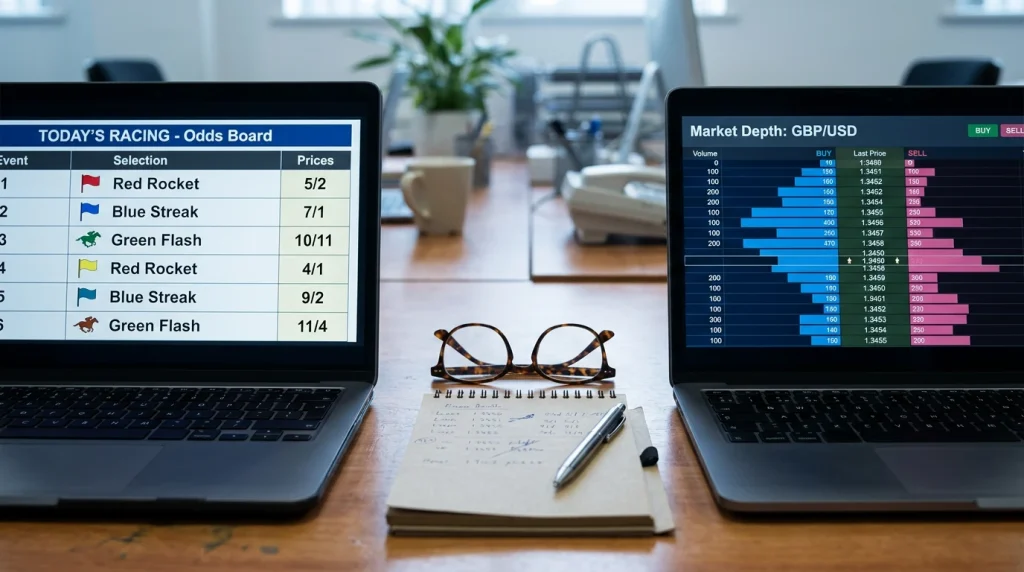
Contents
Two different business models in one market
I placed my first exchange bet in 2017, laying a 4/5 favourite in a novice hurdle at Wetherby because the horse had a jumping flaw I thought would catch it out on a tight track. The favourite fell at the third hurdle and I collected my profit without having backed a single horse. That was the moment I understood that the exchange doesn’t just offer different prices — it offers a fundamentally different relationship with the market. On a bookmaker site, you are always betting against the house. On an exchange, you are betting against other punters, and the house merely takes a cut.
Both models are legal, regulated, and widely used in the UK. Both serve real purposes for different types of punter. But choosing the wrong one for your betting style costs money as surely as picking the wrong horse, and the majority of casual punters have never seriously considered whether their default platform is actually the best fit.
The traditional bookmaker model
A bookmaker sets odds, accepts bets against those odds, and profits from the margin built into every price. The total implied probability of all runners in a race, when summed, exceeds 100% — the excess is the overround, and it is the bookmaker’s structural edge. In UK horse racing, overrounds typically range from 110% to 125% depending on field size and the competitiveness of the market.
The bookmaker decides which prices to offer, can change them at any moment, and can choose to accept or decline individual bets. For the punter, the experience is simple: you see a price, you click, and if the bookmaker accepts, the bet stands. There is no need to wait for another punter to match your position. Execution is instant, and the minimum stakes are low — typically £0.10 or less on most UK platforms.
Total gross gambling yield from remote betting across all sports reached £2.6 billion in the 2026-2026 financial year, with the bookmaker model accounting for the overwhelming majority of that figure. The exchange share of the UK market is significant but substantially smaller, concentrated among a more engaged subset of punters.
How a betting exchange matches users
An exchange operates as a marketplace. Instead of the operator setting odds, individual users offer and request odds. If you want to back a horse at 5/1, you place an order on the exchange. If another user is willing to lay that horse at 5/1 — meaning they believe the horse will not win and are willing to accept your bet — the two orders are matched and the bet is live.
The exchange operator does not take a position on the outcome. Their revenue comes from a commission charged on net winnings, typically 2% to 5% depending on the platform and the user’s volume. This commission replaces the bookmaker’s overround as the operator’s income source, and in most cases it results in a lower total cost to the punter.
The lay side is what makes the exchange genuinely different. On a bookmaker site, you can only back a horse to win or place. On an exchange, you can lay a horse — betting that it will lose. This opens up entirely new strategies: opposing a horse you think is overrated, trading positions as prices move, or hedging an existing bookmaker bet by laying the same horse on the exchange at shorter odds.
The trade-off is execution risk. Your bet only goes live when another user matches it. In liquid markets — the Gold Cup, a Saturday ITV handicap — matching is near-instant. In thin markets — a Monday evening meeting at Plumpton with six runners — you may wait minutes for a match, or not get matched at all if no one is willing to take the other side at your price.
Pricing: where each model usually wins
On average, exchange prices are better than bookmaker prices on favourites and short-priced horses. The absence of an overround means the exchange’s implied probability is closer to the true market view, and the commission is typically smaller than the margin embedded in a bookmaker’s price for horses at the front of the market.
For longer-priced horses — 12/1 and above — the pricing advantage is less consistent. Bookmaker promotions like Best Odds Guaranteed, price boosts, and extra-place offers can push the effective return on a winning bet above what the exchange offers, particularly for each-way punters. The exchange does not offer BOG, and there is no each-way equivalent on an exchange — you would need to place separate back bets on the win and place markets, which introduces additional complexity and commission.
Online gross gambling yield in the remote betting sector grew 8% year on year in the second quarter of 2026, reaching £1.42 billion. The growth was spread across both bookmaker and exchange platforms, but the bookmaker model’s ability to offer promotional incentives — free bets, money-back specials, accumulator insurance — gives it a marketing advantage that the exchange, with its commission-based structure, cannot easily replicate.
My own experience across nine years is that the exchange consistently saves me money on bets at odds of 6/1 or shorter, where the commission is small relative to the return and the overround saving is most pronounced. For bets at 10/1 and above, I compare both platforms on a case-by-case basis, and the bookmaker frequently wins once promotional terms are factored in.
Which punter profile suits which model
The casual punter who bets once or twice a week on Saturday racing, favours each-way multiples, and values simplicity of execution is almost certainly better served by a bookmaker. The bookmaker offers instant execution, promotional incentives, and a straightforward interface that doesn’t require understanding of order books or market depth.
The serious punter who bets daily, focuses on singles, has a systematic approach to identifying value, and wants the ability to lay horses or trade positions will find the exchange indispensable. The exchange also offers a critical advantage for winning punters: it does not restrict accounts. A bookmaker can and will reduce the stakes of any customer they identify as consistently profitable. The exchange, because it matches users rather than taking a book, has no incentive to restrict winners — their commission income increases with turnover regardless of who wins.
The pragmatic punter uses both. I maintain accounts with multiple bookmakers and an exchange account, and I route each bet to the platform that offers the best effective return for that specific wager. A Saturday each-way bet on a 14/1 shot with BOG goes to the bookmaker. A lay of a 6/4 favourite in a novice hurdle goes to the exchange. That flexibility is a structural edge that most casual punters never exploit.
Exchange vs bookmaker FAQ
Articles
Created by the "bethorseracingonline.com" editorial team.
