
National Hunt vs Flat Betting: Two UK Codes, Two Approaches
 Available in US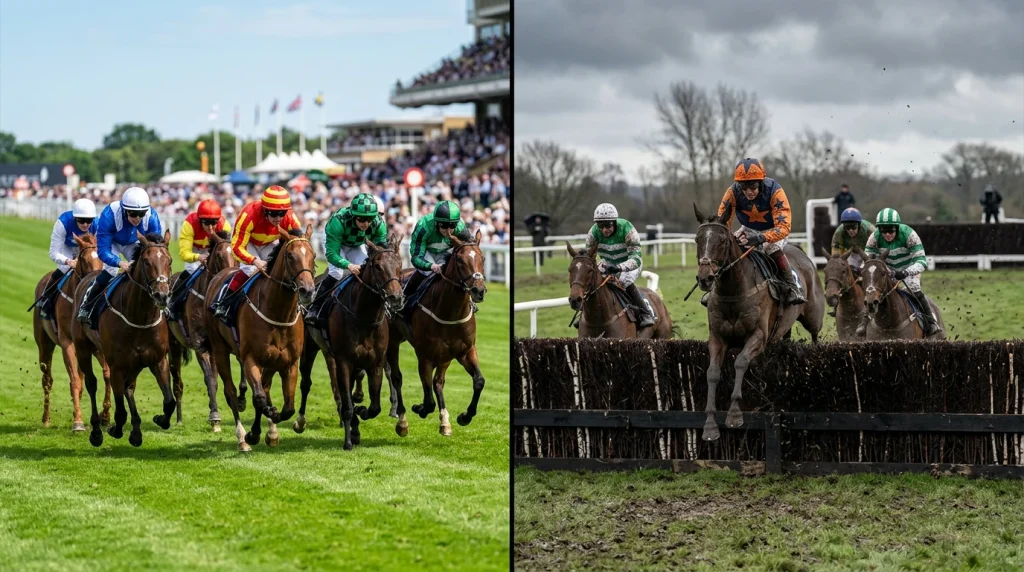
Contents
Two codes, one sport, very different markets
A friend who had spent years betting on National Hunt racing confidently placed his first Flat wager on a Listed sprint at Newmarket. He applied every principle he relied on over fences — recent course form, trainer fitness, the going — and watched his selection finish sixth of seven in a race that was over in 58 seconds. Everything had happened too fast for any of his jump-racing instincts to matter. The winner was a two-year-old with a single previous run, no meaningful course form, and a trainer he’d never heard of. That afternoon taught him something I had already learned the hard way: Flat and National Hunt racing may share a governing body and a general framework, but they reward fundamentally different kinds of analysis.
UK racing’s dual-code structure offers punters a year-round market, with the Flat season running primarily from April to October and the National Hunt calendar dominating from October to April, plus summer jumps fixtures filling the gaps. Understanding which skills transfer between codes and which do not is the difference between a versatile punter and one who is unknowingly misapplying a framework built for the wrong sport.
The Flat: speed, two-year-olds, summer cards
Flat racing is a speed contest over distances from five furlongs to two miles and six furlongs, with the majority of races run between six furlongs and a mile and a half. There are no obstacles, the surfaces are either turf or all-weather synthetics, and the fastest horses at the shortest distances complete their races in under a minute.
The defining feature of the Flat for bettors is the two-year-old population. Every spring, a cohort of juveniles arrives with minimal or zero race form. Their abilities are genuinely unknown, and trainers often keep information close. This creates a market that is structurally different from jumping, where horses typically have extensive career records. On the Flat, you are frequently betting on potential rather than proven output, and the information asymmetry between racing professionals and the public is at its widest. Trainer reputation, breeding analysis, and paddock assessment carry outsized weight in two-year-old races compared to any other category of UK racing.
Older Flat horses, by contrast, tend to produce more predictable form. A six-year-old sprinter competing in heritage handicaps has a career record spanning twenty or more runs, giving the form reader a rich dataset. The analytical challenge shifts from information scarcity to information filtering — working out which runs are representative and which were compromised by ground, draw, or trip.
National Hunt: stamina, jumping, winter cards
National Hunt racing tests a different set of equine qualities. Races are run over hurdles or fences at distances from two miles to four miles and beyond, and the ability to jump accurately at speed is as important as raw galloping ability. A horse that runs faster between obstacles but loses a length at every fence will be beaten by a slower galloper that gains ground through superior jumping technique.
Total UK racecourse attendance in 2026 reached 5.031 million — the first time the figure exceeded five million since 2019 — and the jump season’s marquee festivals at Cheltenham and Aintree contributed a substantial share of that number. The winter code carries an emotional weight and cultural resonance that shapes the betting market: casual punters flood in for the Grand National and Cheltenham, widening the gap between informed and uninformed money.
For the regular jumps bettor, form is more transparent than on the Flat. Most National Hunt horses have long careers with dozens of runs, and the variables that affect performance — going, trip, track configuration, the quality of jumping — are observable and documented. The trade-off is that the attrition rate is higher. Falls, unseats, and pulled-up horses are part of every card, and they introduce a layer of randomness that is almost entirely absent from Flat racing. A horse can be the best in the field and still lose because it clips the top of the fourth-last fence.
Field sizes and place-term implications
The divergence in field sizes between the codes has direct consequences for betting strategy. Average field sizes on the Flat in 2026 were 8.90 runners per race, compared to 7.84 over jumps. That gap looks narrow in the aggregate, but it masks significant variation within each code. Flat handicaps regularly attract 16 to 20 runners, while maiden hurdles might go off with fields of six. Conversely, the big jumps festivals produce fields of 20-plus for their handicap chases and hurdles, while mid-season Flat maidens at Wolverhampton might have just five.
Field size determines each-way place terms, and this is where the codes diverge sharply in betting practice. A typical Saturday Flat handicap at Newbury with 16 runners pays three places at a quarter of the odds. A five-runner novice chase at Wetherby pays only two places, and the place fraction drops to a fifth. The each-way punter who moves between codes without adjusting for field-size norms is systematically mispricing the place part of every bet.
The structural difference runs deeper still. In jump racing, non-runners due to ground conditions are far more common than on the Flat, because the range of going conditions across a winter season is wider and the consequences of racing on unsuitable ground are more severe. A horse entered for a chase on good ground may be withdrawn if the ground turns soft overnight, shrinking the field and altering the competitive landscape after the ante-post market has already formed. Planning for non-runners — and understanding their effect on Rule 4 deductions — is a more frequent necessity in National Hunt than on the Flat.
How market shapes differ between codes
Market behaviour across the two codes follows distinct patterns. Flat markets tend to be sharper and more efficient, particularly in Group and Listed races where the form is well established and the bookmaker tissue is tightly calibrated. Price movements in Flat racing are often driven by professional money, and significant drifts or contractions in the morning market usually reflect genuine information about a horse’s wellbeing or readiness.
Jump markets are softer and more susceptible to emotional betting, especially in the build-up to festivals. The ante-post market for Cheltenham opens months in advance and is heavily influenced by media narratives, pundit preferences, and the halo effect of impressive trial performances. Prices for big-race favourites can be distorted by the weight of recreational money, creating value in the wider market for punters willing to oppose the obvious contenders.
The in-running market is another area of divergence. Flat races, particularly sprints, are often settled before an in-play position can be meaningfully established. Jump races, by contrast, unfold over several minutes and include multiple jumping events that can change the race’s complexion. The in-running bettor has substantially more time and more decision points in a National Hunt race, which is why exchange trading is proportionally more popular in the jumps code.
One factor that unites both codes is the impact of weather on market movement. Late going changes shift prices across the board, but the magnitude tends to be greater in National Hunt racing, where a shift from good-to-soft to soft can eliminate multiple fancied runners and transform the complexion of the entire race. Flat going changes are usually less dramatic in their effect on the market because Flat horses are generally more versatile across a narrower range of ground conditions.
NH vs Flat FAQ
Articles
Prepared by the bethorseracingonline.com editorial staff.
