
Draw Bias on UK Racecourses: Where Stalls Position Really Matters
 Available in US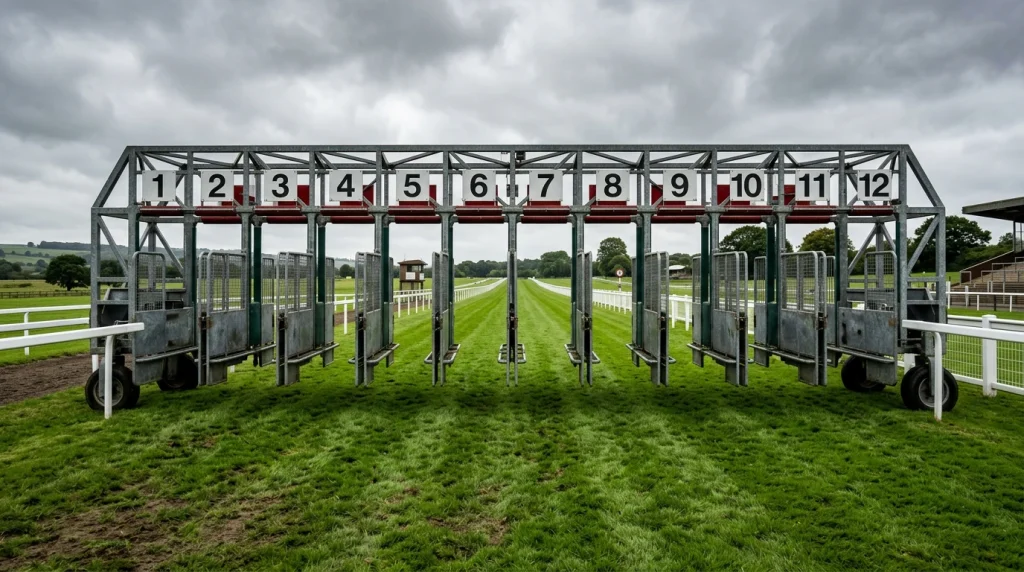
Contents
What draw bias is and where it shows up
I once watched a 6/4 favourite drawn in stall one at Chester finish fourth in a five-furlong sprint, beaten by three horses drawn in the middle to high stalls. The form readers who had him top-rated were right about the horse — they were wrong about ignoring the draw. That afternoon cost me money too, and it was the last time I treated stalls position as a secondary factor on a track where it is anything but.
Draw bias is the statistical tendency for certain stalls positions to produce a disproportionate number of winners or placed finishes at specific courses, distances, and ground conditions. It exists because racecourses are not symmetrical environments. Bends, camber, rail positions, watering patterns, and the angle at which the field enters the straight all create advantages and disadvantages that stalls position either amplifies or mitigates.
Not every course has a meaningful bias, and no bias is permanent. But at the tracks where it exists, it is one of the most reliable edges available to form readers — and one of the most frequently ignored by casual punters who focus on recent form without checking where their selection is drawn.
Why bias appears: bends, going and pace
The physics behind draw bias is straightforward. On a track with a turn shortly after the start, horses drawn on the inside of the bend cover less ground than those on the outside. Over five or six furlongs, where margins are measured in fractions of a length, the extra two or three lengths of ground covered from a wide draw can be the difference between winning and finishing third.
Ground conditions add a second layer. Average field sizes on the Flat dropped to 8.90 runners in 2026 from 9.14 the previous year, which moderates the draw’s impact somewhat — with fewer runners, there is less traffic congestion and more room to manoeuvre. But when fields fill up to 16 or 20 runners for a big handicap, the inside rail gets the heaviest traffic, and the ground there deteriorates faster than the ground on the outside. Early in a meeting on good going, the inside rail may be the best place to race. By the third or fourth race on soft ground, it can be the worst.
Pace dynamics interact with the draw as well. In a race with multiple front-runners drawn high, the field may gravitate towards the far rail early, leaving the stands-rail runners in clean air but on potentially worse ground. Conversely, a race with a single speed horse drawn low can drag the entire field to the inside rail, handing the stands-rail runners a free ride on fresher ground. Reading the pace map alongside the draw is where the analysis becomes genuinely predictive rather than merely statistical.
Bias on major UK Flat tracks
Chester is the most extreme example in British racing. Its tight, left-handed circuit with barely any straight means that low draws dominate on the round course at distances from five furlongs to a mile and beyond. The bias is so well established that it gets priced into the market, but even then, casual punters regularly back horses drawn in double-figure stalls at Chester without adjusting their probability estimates downward. If you fancy a horse drawn in stall 14 at Chester, your assessment of its win probability needs to be substantially higher than the market’s implied chance to justify the bet.
Beverley, a sharp right-handed track in East Yorkshire, shows a low-draw advantage on the straight five-furlong course when the ground is on the quicker side. The camber pushes runners towards the far rail, and those drawn low get there first. On softer ground the bias weakens because the pace drops and jockeys have more time to find a position.
Goodwood’s straight course over five and six furlongs is notorious for switching bias depending on the rail position. The course management moves the rail between meetings, and whatever side has the fresh ground tends to produce the bias. Without checking which rail is in use on the day, historical draw stats for Goodwood are unreliable.
Betting turnover on UK racing fell 9% in the first quarter of 2026 compared with the prior year, partly reflecting smaller fields and fewer competitive handicaps. But the tracks where draw bias matters most — Chester, Beverley, Thirsk, Catterick, Musselburgh — continue to produce pronounced effects precisely because their tight layouts amplify the physics of position.
At Ascot, York, and Newmarket, the bias is milder and more conditional. York’s Knavesmire is largely fair, though slight advantages to high draws appear on the straight course in soft conditions. Newmarket’s Rowley Mile, being a wide, galloping track with a long straight, shows minimal consistent draw bias, making it one of the fairest courses in the country for punters who want to assess ability without stalls-position noise.
Sprint races vs longer trips
The draw’s importance scales inversely with distance. In a five-furlong sprint, the field covers the ground in under a minute and there is minimal time for jockeys to adjust their position. Wherever you start is, largely, where you race. In a mile-and-a-half handicap, the field has time to settle, sort into running positions, and negate a poor draw through patient riding.
This distance gradient means that draw-bias analysis is most valuable for races up to seven furlongs, moderately useful for mile races on turning tracks, and of limited relevance beyond ten furlongs unless the course has an extremely tight configuration. My own records show that incorporating draw data into form analysis adds measurable improvement to probability estimates in sprint handicaps but makes almost no difference in staying races.
The exception is big-field mile handicaps at meetings like Royal Ascot and the York Ebor Festival, where 20-plus runners create congestion that mimics the dynamics of a sprint. In those situations, the draw can re-emerge as a significant factor even at a distance where it would normally be secondary.
Factoring draw into your value bets
The practical challenge is integrating draw bias without overweighting it. A common mistake is to dismiss a well-fancied horse entirely because of an unfavourable draw, when the form advantage may be large enough to overcome the positional disadvantage. The draw is a probability modifier, not a binary filter.
My approach is to estimate the win probability from form, going, and connections first — without looking at the draw. Then I apply a draw adjustment based on the specific track, distance, and ground conditions for that day. At Chester over five furlongs on good ground, a horse drawn in stall 12 of 12 gets its probability reduced by roughly 40-50% from my initial estimate. At Newmarket’s July Course over seven furlongs, the same stall position might warrant only a 5% adjustment. The adjustment percentages come from my own database of results, not from instinct.
Where draw bias creates the sharpest value is when the market has not fully priced it in. If a horse drawn in stall two at Chester is available at 8/1 because its recent form includes a string of disappointing runs on fair-draw courses, but those runs were all from wide draws on turning tracks, the market may be underestimating the improvement that a favourable draw will bring on a course where position is paramount. That scenario — form masked by draw, revealed by draw — is one of the purest value plays in Flat racing.
Draw bias FAQ
Articles
Prepared by the bethorseracingonline.com editorial staff.
